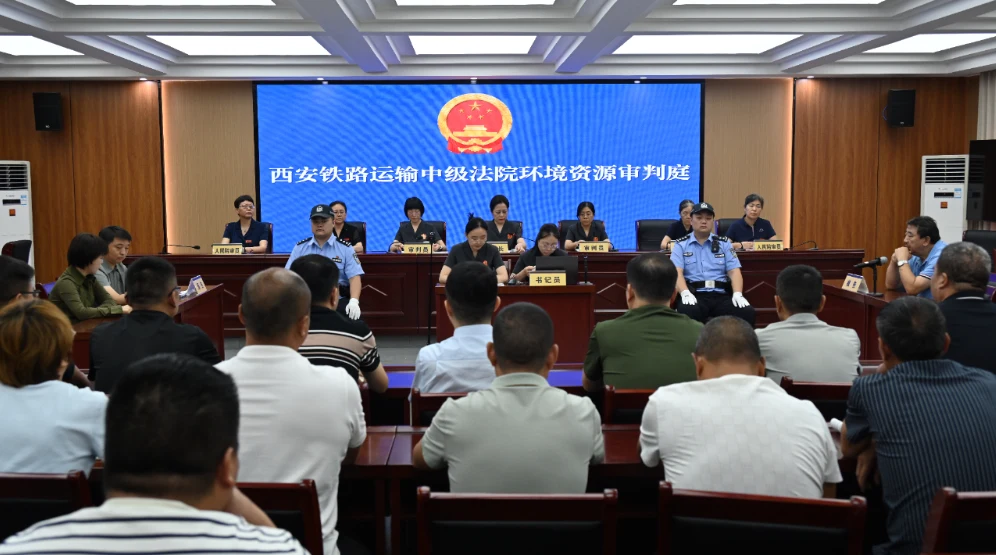
On the first day the Ecological Environment Code of the People's Republic of China took effect, the Xi'an Railway Transport Intermediate Court publicly pronounced a verdict in Ankang: a stone coal mine was ordered to pay compensation for treatment costs and ecological service function losses totaling approximately 14.74 million yuan due to over ten years of illegal open-pit mining and slag without anti-seepage measures causing groundwater pollution. Groundwater function loss was listed and compensated separately for the first time. Ten years of illegal mining, two water body damage chains superimposed In 2004, the mine was granted an underground mining permit, but since 2012 it arbitrarily switched to open-pit mining, excavating and occupying forest land, and piling slag at will. Between 2013 and 2015, the land, water resources, forestry, and ecological environment departments successively imposed multiple penalties and ordered rectification—but the mine never completed treatment, continuing illegal mining while paying fines, lasting more than ten years. In December 2021, when the Third Central Ecological and Environmental Protection Inspection Team stationed in Shaanxi, it was discovered that stone coal mine waste slag in the Haoping River basin was stacked in the open without anti-seepage measures, and leachate was directly discharged, forcing the government to successively implement the Huangnigou and Xianmagou treatment projects to control the spread of pollution.
The most core water body damage chain in this case is: slag stacked in the open without anti-seepage → leachate infiltration polluting groundwater + surface runoff polluting surface water in the Haoping River basin. Over more than ten years, large amounts of ore and slag were stacked in the open, with neither an anti-seepage layer nor leachate collection facilities. Rainwater washing over the slag formed leachate; part flowed along surface runoff into ditches such as Huangnigou and Xianmagou, polluting surface water; the other part infiltrated through soil pores, polluting groundwater. Both types of damage occurred simultaneously and were superimposed over the long term. Groundwater function loss compensated independently, a breakthrough of the Code In April 2025, the Shaanxi Provincial Geological Survey and Experiment Center issued an "Assessment Report", confirming that the mine's illegal acts caused damage to soil, groundwater, and surface water within the assessment area, with a clear causal relationship. After multiple unsuccessful negotiations with the defendant, the Ankang Municipal Natural Resources Bureau filed a lawsuit. In August 2026, the court ruled: the defendant shall compensate 14,506,586.87 yuan for ecological environment treatment costs, plus 2,111,512.44 yuan for soil and groundwater ecological service function losses, appraisal and assessment fees, etc., totaling approximately 14.74 million yuan.
Among them, the groundwater ecological service function loss was listed separately as an independent compensation item—the loss of ecological function value of groundwater in water source conservation, maintaining the water cycle, etc., was separately quantified and compensated, totaling more than 2.11 million yuan together with the soil ecological service function loss. This is precisely a major advancement of the Ecological Environment Code compared with single laws such as the Environmental Protection Law and the Mineral Resources Law. In the past, such mine pollution cases often "emphasized administrative penalties, neglected ecological restoration" and "emphasized direct losses, neglected functional losses", only awarding direct restoration costs and ignoring long-term value losses of ecosystems such as water bodies. Slag stacking without anti-seepage causing groundwater pollution might previously have been settled by paying only a restoration fee. The Code clearly makes ecological service function loss an independent compensation item, truly achieving that groundwater damage is compensated not only for restoration costs but also for functional losses—ecological values such as water source conservation and maintaining the water cycle are separately quantified, making violators pay a price commensurate with the degree of damage.
From "settled after the fine" to full-chain accountability The signal of this case is already clear enough: environmental regulation is moving from "done after the fine" to full-chain accountability of "restoration + functional loss + treatment costs". The mine paid countless fines over ten years while still mining illegally, and what it finally received was not another fine notice, but a court judgment of 14.74 million yuan. Acts such as slag stacking without anti-seepage and wastewater leakage polluting groundwater no longer come with a cost that can be settled with a fine of a few tens of thousands of yuan—once causation is assessed and confirmed, what awaits you may be compensation in the tens of millions. Treating pollution is the best "amulet" Rather than waiting for the court summons to be delivered, it is better to do pollution prevention and control in advance. Ziyun Group has been deeply engaged in the water treatment field for many years, owns more than 200 national patents, and is a "specialized, refined, distinctive and innovative" small and medium-sized enterprise in Shaanxi Province. Its integrated water purification equipment produces stable effluent meeting standards; its inclusive integrated wastewater treatment equipment can achieve reclaimed water reuse, helping enterprises turn wastewater back into usable water—both compliant and money-saving.
In the era of the Ecological Environment Code, a reliable set of water treatment equipment is the most tangible "amulet" for an enterprise.