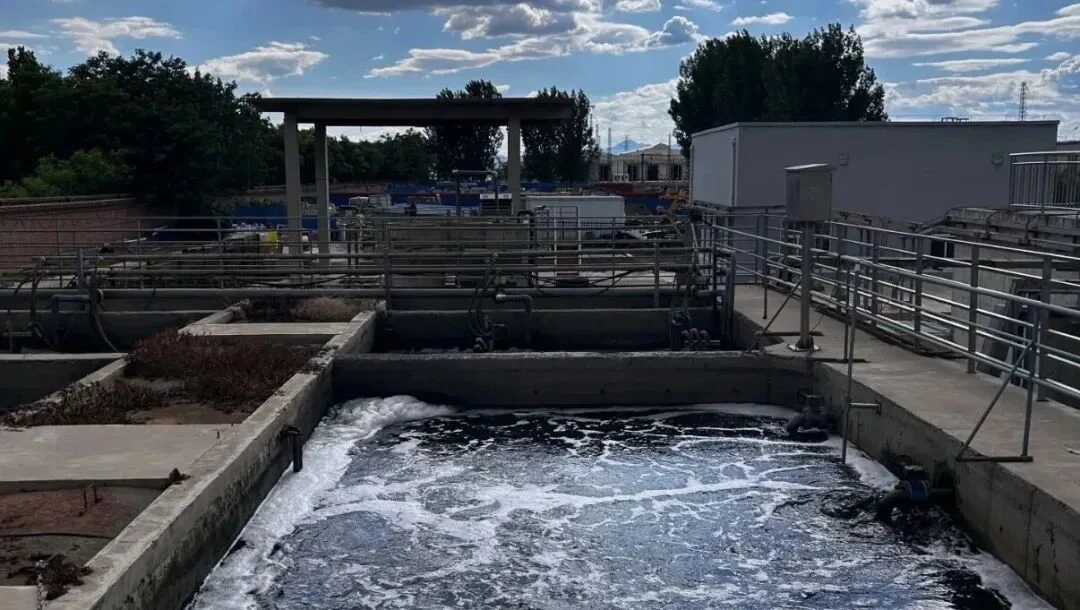
Nearly 600 million invested, 8 sewage treatment plants, all shut down for 3 years. Shuangliao built 6 treatment stations, not a single pipeline network was configured, all idle. Suiping's 14 village-level facilities, not one operating normally. Tengchong's 1,931 natural villages, facility coverage rate below 5%. From the northeast to the southwest, sewage stations built for hundreds of millions are all sitting idle in the sun, while sewage next to them keeps being discharged. The money was spent, the facilities sit empty, the sewage keeps flowing — the entire chain is broken. Where exactly is it stuck? From the northeast to the southwest, sewage stations are all sitting idle in the sun. This is not an isolated case. In 2018, the National Audit Office announced a heartbreaking figure: out of 195 sewage treatment facilities in Jiangsu, 146 were idle, with investment exceeding 100 million, and less than 10% actually operating. In June 2026, the Central Ecological and Environmental Protection Inspection Team discovered in Siping, Jilin, that 6 rural sewage treatment stations completed in Shuangliao City in 2024 had not been equipped with 57.5 km of sewage collection pipelines, and the facilities had remained idle.
The inspection team found during a covert investigation that a treatment station in Boshan Town has a processing capacity of 400 tons/day, domestic sewage in the surrounding area is discharged directly into roadside ditches with obvious odor, and sampling and monitoring showed that chemical oxygen demand exceeded the standard by 17 times and ammonia nitrogen by 82 times. What is even more absurd is that a certain village in the west has a permanent resident population of only 57 people, yet a facility with a daily treatment capacity of 400 tons was built — using a butcher's knife to kill a chicken, there is simply no water to treat. The real ledger of sewage treatment stations: facilities are handed over to townships for management, but townships cannot afford this money. Electricity costs are the major part of operation and maintenance, and electricity bills for small stations can account for 30% to 50% of costs. The state advocates agricultural electricity prices for rural sewage facilities, which can reduce costs by 30%, but the policy is greatly watered down at the local level. They are basically never turned on normally, and are only started to go through the motions when inspections arrive. Rural sewage has no charging mechanism, relying entirely on fiscal appropriations, with slow approval and insufficient quotas. Operation and maintenance funds are the lifeblood of facility operation; once the blood is cut off, the equipment is just a pile of scrap iron. During the 14th Five-Year Plan period, the central finance arranged a total of 19.6 billion yuan for rural environmental improvement funds, but when spread across millions of villages nationwide, it is a drop in the bucket.
Pollution treatment costs 300,000 to 400,000 or even over a million per site, with a huge funding gap. The first break point: lack of money, equipment turns into scrap iron. In terms of quality, safety, and long-term goals, the meeting clearly stated that quality and safety should run through the entire process of construction and operation, strictly controlled from planning and design to construction acceptance and operation and maintenance management, to build a safe and reliable people's livelihood project. During the 15th Five-Year Plan period, the country will build and renovate approximately 770,000 kilometers of urban underground pipelines, and related targets have been included in the main indicators of the Urban Renewal 15th Five-Year Plan. Experts pointed out that this meeting marks a transition in pipeline network construction from large-scale new construction and expansion to a new stage of systematic coordination, root-cause elimination of hidden dangers, integration of construction and management, and full life-cycle control, laying a solid foundation for urban safety, resilience, and high-quality development. From 3.9 million kilometers of existing stock to 770,000 kilometers of renovation, behind it is the systematic elimination of hidden dangers of 'running with diseases' and a comprehensive upgrade of refined governance of urban underground space.
The second break point: lack of pipeline network, having a heart but no blood vessels. Building a facility costs hundreds of thousands, while a kilometer of pipeline network may cost over a million — if the pipeline network is not built, the water simply cannot be delivered. Shuangliao's lesson is the most direct: the stations were built, but not a single kilometer of the 57.5 km pipeline network was configured, the sewage collection rate was too low to operate stably, and the facilities became mere decorations. Building the heart first without connecting the blood vessels, the heart is just a pile of scrap iron. Pipeline network first, connect the blood vessels before building the heart — this is the most basic engineering logic, but quite a few places do it the other way around — build the station first, leave the pipeline network for 'the next step,' and then there is never a next step. The third break point: lack of technology, copying urban standards leads to local incompatibility. Rural sewage is completely different from urban sewage — small volume, large fluctuations, and copying urban standard designs will inevitably be locally incompatible. When the influent chemical oxygen demand is below 80 mg/L, the activated sludge process is difficult to function stably. Some stations are built on high ground, and sewage simply cannot be delivered upward by gravity, so they are just decorations once built.
One operation and maintenance worker has to manage more than a dozen stations, and cannot even run between them all. Mismatched process selection, missing pipeline networks, interrupted operation and maintenance, coupled with information opacity and supervision becoming a dead letter — being conscientious is costly, cutting corners is cheap, bad money drives out good. The entire chain is broken. Pipeline network first, technology adapted, long-term operation and maintenance. The 2026 No. 1 Central Document explicitly requires the coordinated improvement of low-efficiency and ineffective pollution control facilities in rural areas. Pipeline network first, connect the blood vessels before building the heart, and eliminate plants without pipelines. One village, one policy, select the process according to the actual water quality, do not copy urban standards. Investment should be based on actual influent scale and payment mechanisms, operation and maintenance funds must be long-term, and market-based charging should be explored. Building without anyone to manage it is the same as building in vain. From being able to build to being able to manage — the last link in pollution control. Ziyun Group has been deeply engaged in water treatment for many years and owns more than 200 national patents. Its independently developed 'Yuezhou V' inclusive integrated sewage treatment equipment is designed specifically for the pain point of large water volume fluctuations in towns and villages — when the water volume is below 30% of the design volume, the two zones alternate with low-energy operation; when the water volume reaches 50%, the two zones alternate with high-efficiency operation; at full load, both zones operate with high efficiency; fully automatic control with no need for dedicated personnel on duty, remote monitoring with real-time early warning, small footprint, low energy consumption, and strong adaptability, providing a practical solution for rural sewage treatment that is 'affordable to build, reliable to use, and manageable.'