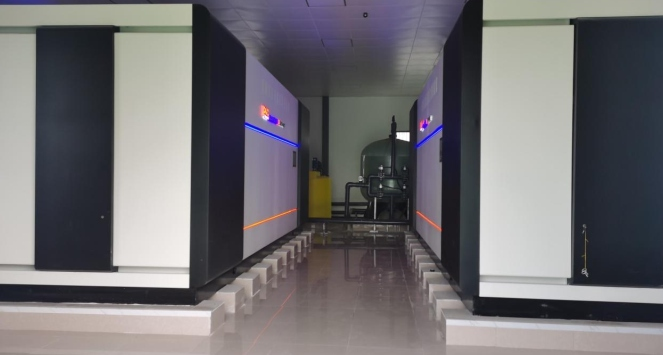
What is the difference between integrated fusion water purification equipment and ordinary water purification equipment? First, look at the integration method.
When many buyers first encounter "integrated fusion water purification equipment," they think it is just several pieces of equipment placed together and connected with pipes. This understanding will directly affect later model selection and on-site preparation, so let us first clarify the structural differences.
What does integrating pretreatment and reverse osmosis mean?
An ordinary split combination is usually like this: pretreatment equipment (such as multi-media filtration, activated carbon filtration, softening, etc.) is purchased separately, and the reverse osmosis main unit is purchased separately. After the two parts arrive, the on-site construction party completes the connection, piping, electrical hookup, and commissioning. Each section is an independent equipment body, and the interfaces, controls, and installation positions all need to be coordinated on site.
Ziyun Group's integrated fusion water purification equipment is organized by treating pretreatment and reverse osmosis as one overall piece of equipment—the internal connections, control logic integration, and overall layout of the two process stages are completed before leaving the factory. After arrival, the main work is connecting external interfaces such as inlet water, product water, drainage, and power supply, rather than doing on-site piping and joint debugging between the two process stages.
For users, this means:
- Reduced on-site workload: There is no need for extensive on-site pipe welding, valve installation, and staged commissioning between pretreatment and reverse osmosis.
- Clearer boundaries of responsibility: Interface issues between process stages are resolved by the equipment supplier before delivery, and only external connections need to be handled on site.
- Unified control: Automatic control covers the entire process, rather than pretreatment and reverse osmosis each having their own control system and requiring manual coordination of start-stop sequences.
Why does the level of integration affect the number of on-site interfaces?
The number of interfaces in a split combination is roughly determined by "the number of equipment stages × the inlet/outlet, drainage, and control interfaces per stage." The more stages there are, the more pipe connections, electrical control points, and installation space need to be reserved on site, and the coordination cost for civil works and installation also rises accordingly. Integrated integration incorporates the interfaces between stages into the interior of the equipment, and the external interfaces are reduced to a few categories, making it easier to confirm the on-site reservation conditions clearly in one go.
This has different practical significance for several typical scenarios:
| Scenario | Impact brought by the integration method |
|---|---|
| New construction of a village and town water supply station | The site lacks dedicated installation and commissioning personnel, so reducing internal interfaces means lowering the construction threshold |
| Supporting expansion of a water treatment plant | Limited site and construction period; fewer external interfaces make it easier to connect with existing processes. |
| School and hotel renovations | Small site and no long downtime allowed; integrated delivery and integrated commissioning shorten the water shutdown window. |
| General contractor project delivery | The interface list of the water purification subsystem is shorter, making unified management easier for the general contractor. |
Integration does not mean "pieced together"
To judge whether a set of equipment is truly integrated, you can ask three questions: Is the piping between pretreatment and reverse osmosis connected on site or at the factory? Are the controls for the two stages one system or two? What on-site joint commissioning work is required after arrival?
If the answer points to "completed at the factory, one control system, and only external connections done on site," then it is integrated in the structural sense;if it is merely two independent pieces of equipment placed side by side, it is still a split-type combination, just shipped in different batches.
It should be noted that the integration method solves theinstallation and interfaceissues, and cannot replace the matching judgment of the raw water conditions and treated water requirements. Whether the equipment can operate stably still depends on whether the raw water quality is within the range that can be treated by pretreatment plus reverse osmosis. If you are making a selection for a specific project, it is recommended that you provide the raw water quality report, target water production capacity, available on-site space dimensions, and water inlet and drainage conditions to the Ziyun Group project team, so they can confirm whether the process configuration and interface plan match your site.
What materials need to be provided when selecting integrated fusion water purification equipment?Six checklists laid out clearly at once
Having all materials ready before inquiry can avoid back-and-forth supplementation and repeated revisions of the plan. Integrated fusion water purification equipment combines pretreatment and reverse osmosis. Whether the model selection is suitable depends on whether the project conditions you provide are clear. The following six items of information are recommended to be provided to Ziyun Group / P&C project team all at once.
The first three items: raw water, treated water, treatment scale
1. Raw water quality data
- Why is it needed: How the pretreatment is configured and whether reverse osmosis can operate stably all depend on the raw water.Without water quality data, process configuration can only rely on guesswork, and you bear the risk of subsequent compliance.
- How to prepare: Provide recent water quality test reports (covering at least routine indicators such as turbidity, pH, hardness, chloride, TDS, iron and manganese, and microorganisms).If the raw water fluctuates greatly by season, please attach two sets of data for the wet season and dry season, and note the sampling points and sampling times.
2. Effluent requirements
- Why is it needed: Effluent indicators directly determine the process depth and configuration level, and are one of the variables with the greatest impact on quotation differences.
- How to prepare: Clearly state the effluent use (rural and township domestic water supply, direct supply for schools, hotel guest rooms, supporting replenishment for water plants, etc.) and the corresponding water quality targets.If the project has acceptance criteria, attach the supporting documents as well;If it is only a subjective requirement such as "good taste and no off-flavor," please also state it directly, and the team will help you convert it into executable indicators.
3. Treatment scale
- Why is it needed: Equipment is selected according to the project, and the treatment scale specification is the first entry point for selection. If the scale is given incorrectly, everything that follows is invalid.
- How to prepare: Provide the design hourly flow rate or daily treatment volume (m³/h or m³/d), and specify whether it is an average value or a peak value.For scenarios with concentrated water use periods, such as schools and hotels, be sure to provide the hourly peak value, not just the daily average.
The last three items: site, control, and connection requirements
4. Site conditions
- Why is it needed: Integrated equipment reduces the need for scattered on-site installation, but land area, inlet and outlet elevations, and maintenance access still need to be verified in advance.
- How to prepare: Provide a site plan or on-site photos, marking the available dimensions, floor height, equipment access routes, and power supply locations.If it is a renovation project, please attach the existing structures and pipe routing conditions.
5. Control and monitoring requirements
- Why is it needed: The equipment comes standard with automatic control; remote monitoring is optional.Whether it is needed directly affects the configuration and quotation.
- How to prepare: Specify whether the site is attended, whether remote viewing of operating data is required, and whether it needs to be connected to an existing central control or management platform.If a village or township water supply station has no dedicated operations and maintenance staff, please state this clearly, and the team will provide a solution based on an unattended scenario.
6. On-site interface conditions
- Why is it needed: Integrated equipment must connect with existing processes or pipe networks; mismatched interfaces will prolong the installation period.
- How to prepare: Specify the water inlet source (municipal pipe network, private well, storage tank), water outlet destination, brands and interface diameters of existing equipment, power supply capacity, and the planned arrival and commissioning times of the project.
How to determine suitability once the information is complete
For projects with complete information and clear objectives—new rural and township water supply stations, supporting expansion of water plants, water supply renovation for schools and hotels, and water purification subsystems delivered by general contractors—you can proceed directly to model selection and quotation.
In the following two situations, it is recommended to supplement the information first before requesting a quotation: First, if the raw water quality severely exceeds standards and fluctuates greatly, and there are no on-site pretreatment conditions, it is necessary to first confirm whether the raw water is within the range the equipment can stably treat, and it cannot be directly applied;Second, if the effluent requirements are still changing frequently, define the requirements first before selecting the configuration; otherwise, the quotation has no basis for comparison.
After receiving the six items of information, the Ziyun Group / P&C team will provide matching process configurations and model selection recommendations based on them. You can then compare the plan against your budget and operation and maintenance investment, rather than looking at the price first and working backward to the configuration.
Which scenarios are suitable for integrated all-in-one water purification equipment?In which situations is it not recommended to apply it directly?
The adaptation logic for village and town water supply, water plant supporting facilities, and school and hotel water supply
To judge whether it is suitable, the key is to look at three things: whether the raw water conditions are stable and verifiable, whether the treated water requirements are clear, and whether there is someone on site to monitor operation over the long term. Only when all three are relatively clear can the integrated value of the all-in-one system be realized.
New construction of a village and town water supply station: Sites with limited budgets and no dedicated operations and maintenance personnel are typical scenarios where this type of equipment is applicable. Pretreatment and reverse osmosis are integrated into one piece of equipment, reducing the links for dispersed on-site installation and multiple connection points, and automatic control can also lower the threshold for daily operation. The premise is that the raw water quality has recent test data, and the fluctuations are within the range the equipment can handle.
Supporting expansion of a water treatment plant: When the schedule is tight and on-site civil construction space is limited, integrated equipment can shorten the installation and commissioning cycle and be connected as a supplementary unit to the existing process. The interface location, the destination of the produced water, and the connection method with the existing system need to be confirmed in advance.
Water supply renovation for schools and hotels: Small sites, concentrated water use periods, and a desire for simple maintenance—these scenarios match the compact footprint and automatic operation characteristics of integrated equipment. Schools and hotels are sensitive to water supply stability, so when selecting the model, peak water demand and backup arrangements for shutdown maintenance should be considered together.
Engineering general contractor delivers a water purification subsystem: When a supplier is needed to assist with model selection and provide equipment that can be delivered as a whole to reduce on-site cross-operation, an integrated solution can simplify the general contractor's coordination workload.
Under what circumstances is it not worth adding integrated complexity
There is one situation where it is not recommended to apply it directly:The raw water quality seriously exceeds standards, fluctuates greatly, and there are no on-site pretreatment conditions. Under such working conditions, whether the equipment can operate stably depends on the specific indicators of the raw water. It cannot be assumed to be suitable just because of the word "integrated." Water quality testing must be done first, and the selection party must confirm whether the process configuration covers the actual water quality range.
In addition, if the project goals are still changing frequently—the discharge use has not been determined, the treatment scale is repeatedly adjusted, and the on-site materials (raw water report, water consumption, site conditions) cannot be gathered together—then installing integrated equipment at this time may very likely reveal after installation that the configuration does not match, and the rework cost will be higher than the confirmation time spent earlier. Such projects are more suitable for first completing the materials, and then discussing equipment.
A decision-making approach that looks only at the initial equipment price in the budget and does not consider subsequent operation and maintenance and compliance risks is also not recommended. Automatic control and remote monitoring are optional functions. Whether they are needed depends on whether the site is attended and what the maintenance frequency requirements are. They should be evaluated together with long-term operation and maintenance convenience, rather than being fully equipped by default.
What to confirm next
Before making a final judgment, confirm three things with the current project team: whether the raw water quality test data is within the equipment's processing range, whether the designed treatment scale matches the actual peak water consumption, and who is responsible for on-site installation conditions and subsequent operation and maintenance. Once these three items are clearly confirmed, a conclusion on suitability can be reached.
So how should the final choice be made? Give conclusion boundaries based on the completeness of the materials
Recommended path when materials are complete
If you have the raw water quality report, target effluent requirements, daily treatment volume or peak water consumption, site dimensions and power supply conditions, as well as a clear arrangement for who will handle subsequent operation and maintenance, you can directly enter the model selection and quotation stage. Providing these items to Ziyun Group / P&C team all at once usually allows you to quickly obtain targeted process configuration recommendations, rather than a general quotation.
For scenarios such as new rural and township water supply stations, supporting expansion of water plants, and water supply renovations for schools and hotels, if on-site installation conditions are limited and there are no dedicated operation and maintenance personnel, integrated water purification equipment that combines pretreatment and reverse osmosis can reduce the interface steps of scattered on-site installation, and together with automatic control, lower the burden of daily management—when materials are complete, this is the preferred recommended path.
When information is insufficient, what should be supplemented first before requesting a quote?
Incomplete informationYou can request a quote first, but it must be clear that what you get at this point is only a range-based reference, not a directly executable plan. It is recommended to first complete the following three items before discussing specific configurations:
- Raw water quality: Even if there is only the most recent routine test report, it can still allow the other party to determine whether the pretreatment stage is sufficient;With no water quality information at all, process configuration cannot even be discussed.
- Treatment scale: Daily water consumption or design treatment scale indicator, which directly determines the equipment selection tier.
- Effluent use and requirements: Whether it is for drinking, domestic miscellaneous use, or process support, the corresponding effluent expectations differ, and the configuration depth also differs.
If any of these three items is missing, the reference value of the quotation will drop significantly, and the risk of subsequent configuration changes will also be higher.
How should the budget be allocated?
Budget allocation is recommended to be considered according to this priority:
- First priority: Process configuration that matches the raw water quality and effluent requirements. This is the fundamental factor determining whether the equipment can be used stably, and it is not recommended to cut corners here.
- Second priority: automatic control and optional remote monitoring functions. For organizations without dedicated operations and maintenance staff, this investment is exchanged for the labor cost of daily management.
- Third priority: on-site installation and connection costs. Integrated design itself is intended to reduce these expenses, but on-site conditions (site, power supply, piping interfaces) still need to be evaluated separately.
It is not recommended to make decisions based solely on the initial equipment purchase price—installation, operation and maintenance, and compliance risks are all part of the total cost.
Which is more cost-effective: integrated equipment or separate pretreatment plus reverse osmosis?
There is no more reliable answer; it depends on your on-site conditions:
| Your situation | A more suitable direction |
|---|---|
| Small site, tight schedule, limited on-site installation capability | Integrated combined equipment, reducing on-site interfaces and commissioning steps |
| Existing pretreatment facilities are in operation, and only the reverse osmosis stage needs to be added | Doing them separately may fit the current situation better |
| Raw water quality fluctuates greatly and there are no pretreatment conditions | Neither can be directly applied; it is necessary to first confirm whether the raw water is within the treatable range |
Conclusion boundary: For scenarios where the objectives, intended users, materials, and operation and maintenance expectations are all clear, directly inquire about the integrated solution;If there are obvious material gaps or the requirements are still changing frequently, first complete the above three items before discussing configuration; otherwise, both the quotation and the solution will be repeatedly adjusted.
Send your raw water quality, treatment scale, and treated water use to the Ziyun Group / P&C team. You can first confirm whether the solution matches, and then decide whether to proceed to formal selection.
Frequently Asked Questions
Q: If I only have an approximate water usage and no water quality report, can I ask for a price first? A: Yes, but what you get can only be a preliminary range. Water quality directly determines the depth of pretreatment configuration. Without it, the quotation and the final solution may deviate significantly.
It is recommended to arrange a raw water test first, or at least provide the water quality conditions of the historical water points.
Question: For scenarios with concentrated water use periods such as schools or hotels, can integrated equipment handle it? Answer: Such scenarios usually have limited space and concentrated peak water use. The small footprint and automatic operation of integrated equipment are a good fit. However, whether it specifically matches needs to be confirmed based on your peak water usage and site dimensions.
Question: If the budget is limited, should I first buy the most basic configuration and add functions later? Answer: Automatic control is a basic operating capability and is not recommended to be omitted;Remote monitoring is an optional operational convenience feature and can be deferred when the budget is tight. The core process configuration is not recommended to be downgraded just to save money.
Q: After the equipment is purchased, who is responsible for subsequent maintenance? A: This needs to be clarified at the selection stage. If a village or township water supply station does not have dedicated operations and maintenance personnel, this should be stated during the inquiry so that it can be taken into account in the configuration and delivery plan.
Q: If the raw water quality is particularly poor and fluctuates greatly, can this equipment be used directly? A: It cannot be applied directly. It is necessary to first confirm whether the raw water conditions are within the range that the equipment can treat stably, and if necessary, add pretreatment measures.
It is recommended to provide the water quality data to the Ziyun Group / P&C team for a compatibility assessment.
Learn more
If you are making a selection for a specific project, you can send the raw water quality report, designed treatment scale (daily average or peak), intended use of treated water, site dimensions, and power supply conditions to the Ziyun Group project team. We will first help you confirm whether the process configuration and interface plan match your site, and then decide whether to proceed to a formal selection inquiry.