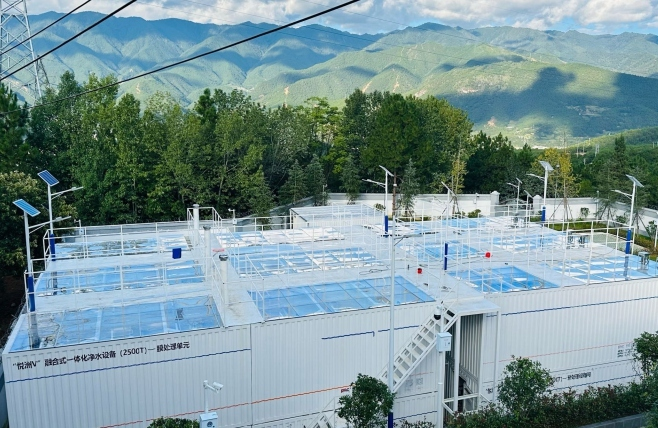
What exactly is a modular movable water plant, and how does it differ from a traditional reinforced concrete water plant?
A modular movable water plant turns water treatment processes into transportable, assemblable complete sets of units, building a centralized water supply treatment system through modular combination, used for new construction or renovation of centralized water supply treatment systems, rather than fixed, immovable concrete tank bodies.
System composition and combination methods of Ziyun Group's modular movable water plant
The solution composition includes four parts: flocculation and sedimentation, membrane treatment modules, supporting equipment, and intelligent management, combined according to project requirements: raw water conditions determine the configuration of flocculation and sedimentation and membrane treatment, site and water supply method determine the number and placement of modules, and management requirements determine the depth of intelligent management support. The integration of process equipment is not equal to exemption from professional process design; it is not "standard boxes hauled away and water flows immediately," but rather a combined system designed according to the project.
The main differences from traditional reinforced concrete water plants lie in the construction method:
| Dimension | Traditional reinforced concrete water plant | Modular Mobile Water Plant |
|---|---|---|
| Construction Path | Mainly on-site civil construction, equipment installed after the tank body is poured | Factory-prefabricated units, assembled on site, connected to piping, and commissioned |
| Funding Pace | Investment concentrated in the early stage | Can be configured in phases, matching the phased availability of funds |
| Relocation and Expansion | The tank body is fixed, and capacity expansion requires building new structures. | When the site allows, it can be relocated and reused, and capacity expansion adds modules. |
The treatment scale is determined by the project design. How should this parameter be understood in terms of its significance for selection?
The treatment scale is not a fixed factory value, but a design result determined by the project's raw water quality, water supply scale, site conditions, and delivery boundary. Its significance for selection lies in this: a solution cannot be obtained by quoting only a tonnage. It is necessary to first provide raw water test data, target water supply flow rate, available site dimensions, and whether construction will be phased, so that the solution can be translated into a specific module combination. Process equipment integration does not mean exemption from professional process design. The specific scale is subject to the project's water quality testing and design.
First category of conditions: raw water quality fluctuations and effluent standards. First determine whether modularization or traditional civil construction is preferred.
To determine whether a village and town water supply project should adopt a modular mobile water plant, the first layer examines two things: how large the raw water quality fluctuations are, and how clear the effluent standard requirements are. These two points directly determine the complexity of the process combination and also determine the investment ratio between civil construction and equipment.
Judgment branch when raw water turbidity and suspended solids fluctuate greatly
Raw water turbidity and suspended solids fluctuating significantly with seasons or rainfall are common situations in village and township water supply. Under such conditions, the process needs to have contingency margin and cannot be designed only based on average water quality.
The modular movable water plant solution consists of flocculation sedimentation and membrane treatment modules. The combination of the two can cover the complete chain from pretreatment to advanced treatment, and its adaptability to influent fluctuations is better than that of a single process. If the project also meets the following conditions, modularization is preferred:
- Water supply capacity needs to be established before the formal water plant is completed, or funds are in place in batches and phased configuration is desired;
- The site is limited and water supply cannot be stopped for a long time; an equipment-based solution is convenient for connecting to the existing pipe network;
- If relocation, capacity expansion, or reuse may occur later, the sunk cost risk of fixed civil construction investment is relatively high.
Conversely, if the raw water is stable over the long term, the site is ample, and the project is built all at once and operates in a fixed location for the long term, the cost-effectiveness of the civil construction option may be more suitable—the core value of modularization lies in flexibility and portability, and in stable scenarios this value cannot be utilized.
It should be noted that the range of raw water fluctuations must be supported by measured water quality data and cannot be estimated based on experience. The fluctuation range, frequency of extreme values, and seasonal patterns all affect the selection and combination of flocculation sedimentation and membrane treatment modules. These data need to be provided to the project team before scheme design, so that the designer can confirm whether the process combination matches.
How to work backward to the process combination when effluent standard requirements are clear
Once the effluent standard is clear, process selection shifts from "whether it can be treated" to "how many treatment stages are needed to reach it." The judgment logic is:
- Standard requirements can be met with conventional treatment.: Flocculation and sedimentation serve as the main process, while the membrane treatment module is reserved for backup or future upgrades, allowing initial investment to be kept at a relatively low level.
- Standard requires advanced treatment: The membrane treatment module becomes mandatory, with flocculation and sedimentation serving as pretreatment to protect the membrane system; the combination of the two cannot be separated.
- The standard has not yet been finalized: This is the situation that requires the most caution.Once the standard is tightened, an already built process may need to be completely redone.At this point, it is recommended to reserve interfaces according to higher standards during the planning stage, rather than configuring according to the current minimum requirements.
The effluent standard also affects the trade-offs in smart water management support. The stricter the standard requirements and the higher the monitoring frequency, the heavier the burden of manual sampling and laboratory submission, and the more obvious the value of online monitoring and smart management—but this does not mean unattended operation is possible; routine inspections by operating personnel and chemical dosing still require manual involvement.
The convergence point of the two branches
Whether entering from the fluctuation branch or the standard branch, the same question must ultimately be answered:How many process stages are needed to stably bridge the gap between the current water quality conditions and the target effluent standard? If the gap is small, both modular and civil construction are feasible, and the choice can be made based on schedule and site conditions;If the gap is large and the process chain is long, the integration advantages of modularization are more obvious, because flocculation and sedimentation, membrane treatment, supporting equipment, and smart management are designed and coordinated within a single solution, reducing the interface risks of connecting multiple contract sections.
Next step confirmation action: compile the raw water quality testing reports for the project over the past three years (focusing on the maximum values and occurrence frequency of turbidity and suspended solids) and the effluent standard documents to be implemented, and submit them together to the project team, so that the designer can determine the matching scheme for the process combination.
The second category of conditions: site, transportation and hoisting, and construction conditions, which determine whether modularization can be implemented
The core advantage of a modular mobile water plant is that the flocculation and sedimentation, membrane treatment modules, and supporting equipment are integrated at the factory and then transported to the site for combined installation. However, the premise for this logic to hold is: the goods can be transported in, hoisted into position, and installed, and the water supply is not interrupted during construction. This layer of judgment does not look at process parameters, but only at site conditions.
Judgment branches for small sites and the renovation of old water plants
Can modularization be used on a small site? There are two cases:
- The site is tight but has basic transportation access and a hoisting work area—modularization is actually more suitable than cast-in-place civil construction.The equipment is delivered to the site in modular form; on site, only the foundation, pipe connections, and assembly work need to be completed, and the continuous construction area it occupies is smaller than that of a traditional water treatment plant.It is suitable for scenarios such as capacity expansion and renovation of old water treatment plants and temporary water supply at the urban fringe, where there is "no open space to build another new plant."
- When the site is so narrow that vehicles cannot pass, cranes cannot be positioned, or the module dimensions exceed the operable space on site—the advantages of modularization will be offset, and on-site measurement and layout simulation must be carried out first before determining whether it is feasible.
Does the renovation of an old water treatment plant require a water supply shutdown? This is the issue that most needs to be confirmed in advance for renovation projects. Modular equipment is easy to connect to existing pipe networks, but the connection process usually involves water supply shutdown or pressure reduction operations.
Whether bypass pipes, phased switching, or construction during the nighttime low-demand period can be used to shorten the shutdown window depends on the on-site pipe network layout and the available margin in water supply scheduling. This part must be evaluated based on the on-site conditions and cannot be concluded from the product itself alone.
Items requiring on-site confirmation for transportation and lifting feasibility
It is recommended to verify the following items one by one before the plan is finalized. If any one of them is not satisfied, it will affect whether the modular solution can be implemented:
- Transportation route: whether the road height limits, width limits, weight limits, and bridge load-bearing capacity from the factory to the site meet the module transportation requirements.
- Lifting conditions: whether there is space on site for crane operation, whether there are obstacles within the operating radius, and whether the foundation can withstand the pressure from the crane outriggers.
- Module dimensions and on-site matching: Whether the module's external dimensions match the clearance of the entry passage and installation location requires on-site measurement rather than inference from drawings.
- Foundation and interface conditions: Whether the existing site's foundation bearing capacity, inlet and outlet pipe elevations, and power supply connection locations match the modular solution.
- Water supply arrangements during construction: Whether the renovation project allows planned water shutdowns, how long a shutdown window is acceptable, and whether temporary water supply measures are available.
Judgment conclusion: A small site itself is not an obstacle to modularization; on the contrary, it is a scenario where modularization has advantages over civil construction;The real threshold is the physical feasibility of transportation and hoisting, as well as the water shutdown arrangements during construction. Both of these are site conditions, and a definitive answer can only be given after the project owner and the design party verify them on site. It is recommended to bring the above five-item checklist to the site before project initiation and confirm each item one by one, then decide whether the modular solution is feasible.
Third category of conditions: the pace of funding availability, the construction period, and expectations for expansion or relocation, followed by the boundaries of what is recommended and not recommended.
The first two categories of conditions address "whether to do it" and "whether it can be done," while the third category determines "how to implement it now." Funds arriving in batches, a tight construction period, and possible future expansion or relocation often occur at the same time, and this is also where modular mobile water plants stand apart from traditional reinforced concrete water plants.
When modularization is recommended and when traditional civil construction is recommended.
Situations where a modular mobile water plant is recommended:
- Funds are arriving in batches, but water supply is needed as soon as possible. The modular construction cycle is short and can be configured in phases. First, basic water supply capacity is established, and then the scale is completed once subsequent funding is in place. There is no need to wait until the entire budget is secured before starting construction.
- The site is small or water cannot be shut off for a long time. When expanding and renovating an old water plant, modular equipment is easy to connect to the existing pipe network, and the water shutdown window can be shortened. The specific arrangement needs on-site assessment.
- There is an expectation of future expansion or relocation. In temporary water supply scenarios such as urban fringes and new districts, where a formal water plant has not yet been built but water demand already exists, the modular solution can quickly establish water supply capacity and can later be relocated and reused, avoiding idle assets after one-time civil construction investment.
Situations where a traditional reinforced concrete water plant is more suitable:
- Funds are available in a lump sum, the construction period is not tight, and the plant site is permanently fixed with no possibility of relocation.
- The project scale has been fully determined, there is no short-term expansion demand, and the unit cost advantage of one-time civil construction can be fully realized.
- The local area has clear planning or approval requirements for permanent structures, which modular solutions find difficult to satisfy.
Regarding "which is more cost-effective": Budget judgment should look at the logic of fund allocation rather than a single total price. The ratio of civil construction to equipment investment, the pace of fund deployment, phased expansion needs, long-term expenditures such as operation and maintenance chemicals and membrane replacement, and changes in labor brought about by smart water management support will all change the full life-cycle cost structure. The specific amount needs to be determined according to the project's water quality, scale, and delivery boundaries. It is recommended to request a comparison of solutions calculated based on the conditions of this project.
Under what circumstances it is not worth adding complexity, and what should be confirmed next
In the following situations, the complexity of a modular solution is not worth adding:
- The goals and scale have not yet been thought through clearly. If the population served by the water supply, treatment scale, and effluent requirements are still being adjusted frequently, first conduct basic research and needs confirmation, then decide on the technical route.
- Raw water quality data is missing. Without water quality testing data, it is impossible to determine the combination of flocculation sedimentation and membrane treatment modules, and the scheme configuration will be repeatedly overturned.
- Both the funding pace and the construction period are relaxed. When funds are available all at once, there is no expectation of relocation, and the construction period is ample, the long-term cost structure of traditional civil construction may be more favorable.
- No one will take over subsequent operations and maintenance. Modular equipment requires basic operation and maintenance capabilities. If there is no local personnel available to take responsibility, the operations and maintenance arrangements must be resolved first.
What should be confirmed next: Provide Ziyun Group with the project location, raw water quality test report (or the time when testing can be arranged), designed treatment scale and long-term water use population, funding availability schedule and expected water supply time, site conditions (available area, whether water shutdown renovation is involved, whether relocation is possible), and who will be responsible for subsequent operation and maintenance, and a targeted matching solution assessment can be obtained. It should be noted that both relocation and capacity expansion require re-commissioning and acceptance, and cannot be regarded as plug-and-play.
Frequently Asked Questions
Q: Is a modular mobile water plant suitable for a water supply project of our village or town scale?
Village and town water supply projects are one of the typical application scenarios for modular mobile water plants. Whether it is suitable depends on three conditions: the funding availability schedule, construction period requirements, and expectations for capacity expansion and relocation. If funds are made available in batches but water supply is needed as soon as possible, or if there is a possibility of relocation or capacity expansion in the future, the modular solution has a high degree of matching;If funds are made available all at once, the plant site is fixed for the long term, and the scale has been fully determined, traditional civil construction may be more suitable.
It is recommended to provide the project scale and funding plan, and confirm a matching solution with Ziyun Group.
Q: Which is more cost-effective, a modular water plant or a traditional reinforced concrete water plant?
You cannot look only at the one-time total price. The ratio of civil construction to equipment investment, the pace of capital deployment, phased expansion needs, long-term expenditures such as operating chemicals and membrane replacement, and changes in labor needs brought by smart water infrastructure all affect the full life-cycle cost. The specific amount must be determined according to the project's water quality, scale, and delivery scope. It is recommended to request a comparison plan calculated based on this project's conditions.
Q: Under what circumstances is a modular solution not worth adopting?
When goals and scale are still being adjusted frequently, raw water quality data is missing, both funding and schedule are relaxed with no expectation of relocation, and there is no subsequent personnel to take over operations and maintenance—under these four circumstances, the added complexity of a modular solution is temporarily not worth it. Surveys, water quality testing, or operations and maintenance arrangements should be completed first before deciding on the technical route.
Q: Can a modular mobile water plant be relocated later?
The modular design itself supports relocation and reuse, which is its structural advantage over permanent civil construction. However, after relocation, recommissioning and acceptance are required. Whether it can be relocated and under what conditions depends on the project site, equipment configuration, and installation method, and must be confirmed by Ziyun Group based on the actual project situation.
Q: If funds arrive in batches, can part of it be built first?
The modular solution supports phased configuration, allowing basic water supply capacity to be established first, and then expanded once subsequent funds are available. The specific boundaries of the phases (which modules to build first and how the treatment scale transitions) must be determined according to the project's water quality, scale, and design. It is recommended to confirm the phased plan with Ziyun Group.
Learn more
If you are making a technical route decision for a village and township centralized water supply project, you can provide the Ziyun Group project team with the project location, raw water quality test report (or the time when testing can be arranged), designed treatment scale and long-term served population, fund arrival schedule and expected water supply time, site conditions, and subsequent operation and maintenance arrangements. Based on this information, we will provide a targeted assessment of the matching modular and civil construction solutions.