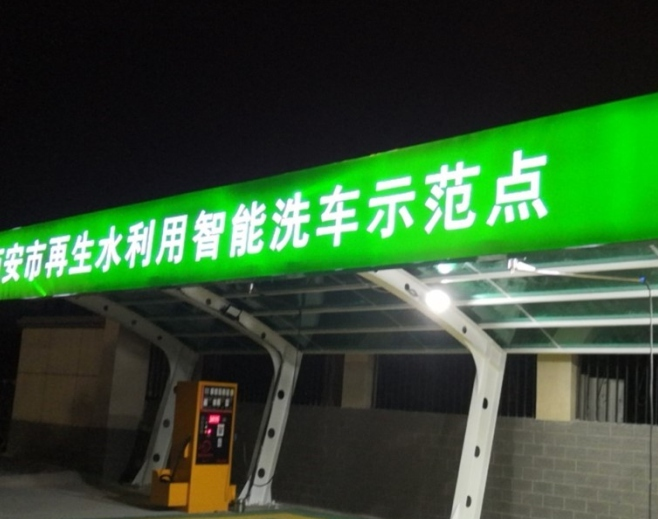
What kind of water does a reclaimed water reuse system actually treat wastewater into?In which non-potable scenarios can it be used?
What a reclaimed water reuse system does is treat the wastewater generated by a park or project to a water quality that meets the requirements of specific uses, and then send it back to non-potable links for use. What it produces is not water of a single quality, but reclaimed water supplied through separate routes according to use—landscape irrigation, road washing, and car washing have different water quality requirements, and the system needs to match the treatment depth according to the boundary of each use. The product is aimed at parks, municipal project owners, and public facility operating units, and the reuse purposes are determined according to the project's effluent water quality and use requirements.
Looking at a park's daily water use flow: when and where do landscaping, washing, and car washing each take place?
Landscape irrigation usually takes place in the early morning or evening, with water points scattered at the edges of green spaces, tree pits, and flower beds; in the dry season, the conflict over municipal water supply with production and domestic water use is most prominent. Road washing is mostly carried out at night or in the early morning when traffic is sparse, with water intake points distributed along main roads and plazas; water needs to be connected nearby, and whether the pipeline layout is in place directly determines whether it can be put to use. Car wash water is concentrated during the daytime at fixed locations, but its requirements for water turbidity and appearance are higher than the previous two—if it shares the same water line with greening, problems such as inadequate cleaning or water marks may occur, so it is necessary to evaluate whether to supply water of separate quality.
Basic working mode of the reclaimed water reuse system: combination of photocatalysis and membrane treatment, digital monitoring, and reuse by purpose
The reclaimed water reuse system of Ziyun Group / P&C adopts a combined process of photocatalysis and membrane treatment, together with digital monitoring, to achieve reuse by purpose. Photocatalysis is responsible for degrading some organic pollutants, while membrane treatment is responsible for intercepting suspended solids and microorganisms; the specific effluent indicators are determined according to the purpose required by the project. The role of digital monitoring is to make operational data traceable, making it convenient for operation and maintenance personnel to view the operating status of each stage, but this does not mean that on-site operation and maintenance are unnecessary.
What needs to be confirmed is: in your project, do greening, washing, and car washing share the same water line, or are they supplied separately? This determines the pipeline investment and the complexity of subsequent operation and maintenance, and is also the first step in judging whether the system is suitable.
Greening irrigation, road washing, and car washing: where do the concerns about reclaimed water differ among these three uses?
Looking at these three scenarios together, it is easy to conclude that "since they are all non-potable, one set of water is enough." In actual projects, what determines how the reuse system should be designed and whether separate quality water supply is needed is precisely the differences in their concerns.
Landscape irrigation: why the long-term impact on plants and soil deserves the most attention
The risk of landscape irrigation lies not in "the moment of watering," but in the cumulative impact on plants and soil after continuous use. Components in reused water will enter the root zone and soil layer year by year with irrigation; problems may not be visible in the short term, but over the long term they may affect growth vigor or soil condition.
Therefore, the question that should be asked most in this scenario is: is this water stream used for long-term, stable irrigation of the park's landscaping, or only for occasional supplementation? If it is the former, the focus should be on long-term compatibility with plants and soil, rather than merely looking at whether the appearance is clear. Landscape water use can usually accept relatively relaxed appearance requirements, but the long-term impact of its components cannot be relaxed.
Road washing and car washing: what marks, odor, and visual cleanliness each mean
Road washing covers a large area and is performed at a fixed frequency, and the most direct issue is whether marks are left after drying. When suspended solids or dissolved substances in the water are relatively high, water stains or white spots are likely to appear on the road surface after drying, affecting the visual impression. Washing is mostly carried out in open spaces, so noticeable odor directly affects the perception of nearby people.
Car washing involves vehicle surfaces and a relatively enclosed working environment, and visual cleanliness is a hard requirement: after drying there must be no residue and no streaking, and odor and foam performance also affect the working experience. Car washing usually has higher water quality requirements than landscaping, and may even be higher than general road washing.
This also explains a common judgment: if a car wash point and landscaping share the same water line, a situation may arise where "the water is sufficient for landscaping but not for car washing." Whether to supply water of different qualities is worth evaluating at the planning stage, rather than changing it after construction.
The three uses have different concerns, which does not mean the same set of water quality standards can be used. Specific water quality requirements shall be determined according to the project's effluent water quality and use requirements, and must be confirmed with the product supplier.
Which uses can share one water line?Which uses are recommended to have separate quality water supply?
To determine whether one water line can be shared, first check whether the same water line can simultaneously meet the water quality and appearance requirements of all uses, and then discuss pipeline complexity.
Typical cases where one water line can be shared: the matching logic of greening and road washing
The water quality requirements for greening irrigation and road washing are usually similar: no human contact and no requirement for clear appearance. The water use peaks of the two uses also often stagger: greening is concentrated in the dry season, while road washing mostly occurs in fixed time periods. When the park has only these two types of non-potable demand, sharing a single reclaimed water line is usually the simpler choice, with fewer pipes and metering points and a clearer inspection route.
The prerequisite is that the water intake points are not too scattered; otherwise, the pipeline investment will offset the benefits of sharing.
Signals suggesting separate quality-based water supply: car washing, scenarios with high appearance requirements, multi-user management
If any of the following situations occurs, it is recommended to evaluate separate quality-based water supply:
- Car washing: The water quality and appearance requirements are higher than those for greening water, and sharing a single line with greening may not meet the requirements, with rework costs higher than laying an additional line.
- Scenarios with high appearance requirements: Landscape replenishment, washing around venues, etc., where fluctuations in water quality will be directly perceived.
- Multiple users and multiple management entities: Sharing a single line makes metering, cost allocation, and O&M responsibilities difficult to delineate clearly.
Separate-quality water supply increases pipeline scheduling complexity and construction investment, but it can reduce the risk of mismatched uses. In multi-purpose, multi-user scenarios, the water quality boundaries for each use must be clarified during the design and acceptance stages, and O&M responsibilities must be divided in advance.
How to choose a reclaimed water reuse system?First look at process suitability, O&M capability, and cost boundaries
For selection, first clarify the influent conditions, design water volume, reuse purpose, installation conditions, and operation management requirements; do not look only at equipment treatment capacity. Different uses require separately confirming the corresponding water quality requirements before discussing processes and piping.
Applicable conditions for the combination of photocatalysis and membrane treatment: not all water quality and scales are suitable
The combination of photocatalysis and membrane treatment has applicable conditions. Membrane treatment focuses on retaining suspended solids and colloids, while photocatalysis targets dissolved organic matter and other parts that membranes cannot reliably remove; the combination of the two is suitable for projects with large influent fluctuations and reuse purposes that require high water quality consistency. If the influent is stable, the purpose is single (such as only greening irrigation), and on-site space and operation and maintenance manpower are limited, a simple process route may be more appropriate.
The judgment basis is the magnitude of influent fluctuations, the number of reuse purposes, whether separate quality water supply is adopted, and whether the site can undertake the daily maintenance of membrane modules.
What digital monitoring can help with and what it cannot replace: operation and maintenance responsibilities still need to be implemented on site
Digital monitoring helps reflect operating status, water quality trends, and alarm information, and improves data traceability, making it easier to explain operating conditions to superiors or regulators. However, it does not replace on-site inspections, membrane module cleaning and replacement, chemical dosing, and judgment of abnormal working conditions. If the project lacks a clear operations and maintenance entity and response mechanism, monitoring alone cannot fulfill operational responsibilities.
Cost composition and situations where adding complexity is not worthwhile
Costs fall into two parts: construction investment and long-term operation. On the construction side, the focus is on process equipment, separate-quality water supply pipelines, and monitoring systems;on the operation side, the focus is on energy consumption, chemicals, membrane replacement, and manual maintenance. Different uses and scales affect which cost items account for a higher proportion, and this needs to be calculated based on the actual project. This article only discusses the logic of composition and influencing factors, and does not provide specific prices, energy consumption values, or payback period commitments.
In scenarios where goals are unclear, information is insufficient, or expectations change frequently, adding complexity is not recommended. When the use is single-purpose, water quality is stable, there is no dedicated operations and maintenance staff, and a simple solution can already cover the main issues, the simpler route should be preferred.
Frequently Asked Questions
Is photocatalytic treatment combined with membrane treatment better than a single process? Not necessarily. Combined processes address problems that a single process finds difficult to handle reliably.
For scenarios with stable influent and a single purpose, a simple process may be more suitable.
Can digital monitoring replace on-site operation and maintenance? No. It provides data support and early warnings, but cleaning, membrane replacement, chemical dosing, and handling of abnormalities still need to be carried out on site.
What are the main factors for investment and operating costs? On the construction side, look at process equipment, piping, and monitoring;on the operation side, look at energy consumption, chemicals, membrane replacement, and labor. The specific proportions need to be calculated based on the actual project.
Under what circumstances is it not worth adding complexity? When the goal is unclear, information is insufficient, expectations change frequently, or the use is single-purpose, water quality is stable, and there is no dedicated operations and maintenance staff.
How to make the final decision? First clarify the reuse purpose and water quality boundaries, then confirm the on-site operations and maintenance capabilities, and finally check whether the budget can cover long-term operation. Only when the three match does the solution hold.
Learn more
If you are planning a non-potable water supply solution for a park, you can compile the influent conditions, design water volume, reuse purposes, installation conditions, and operation and maintenance arrangements, and we will help you determine which uses can share a single water line, which are recommended to use separate quality water supply, and match the corresponding reclaimed water reuse system configuration.