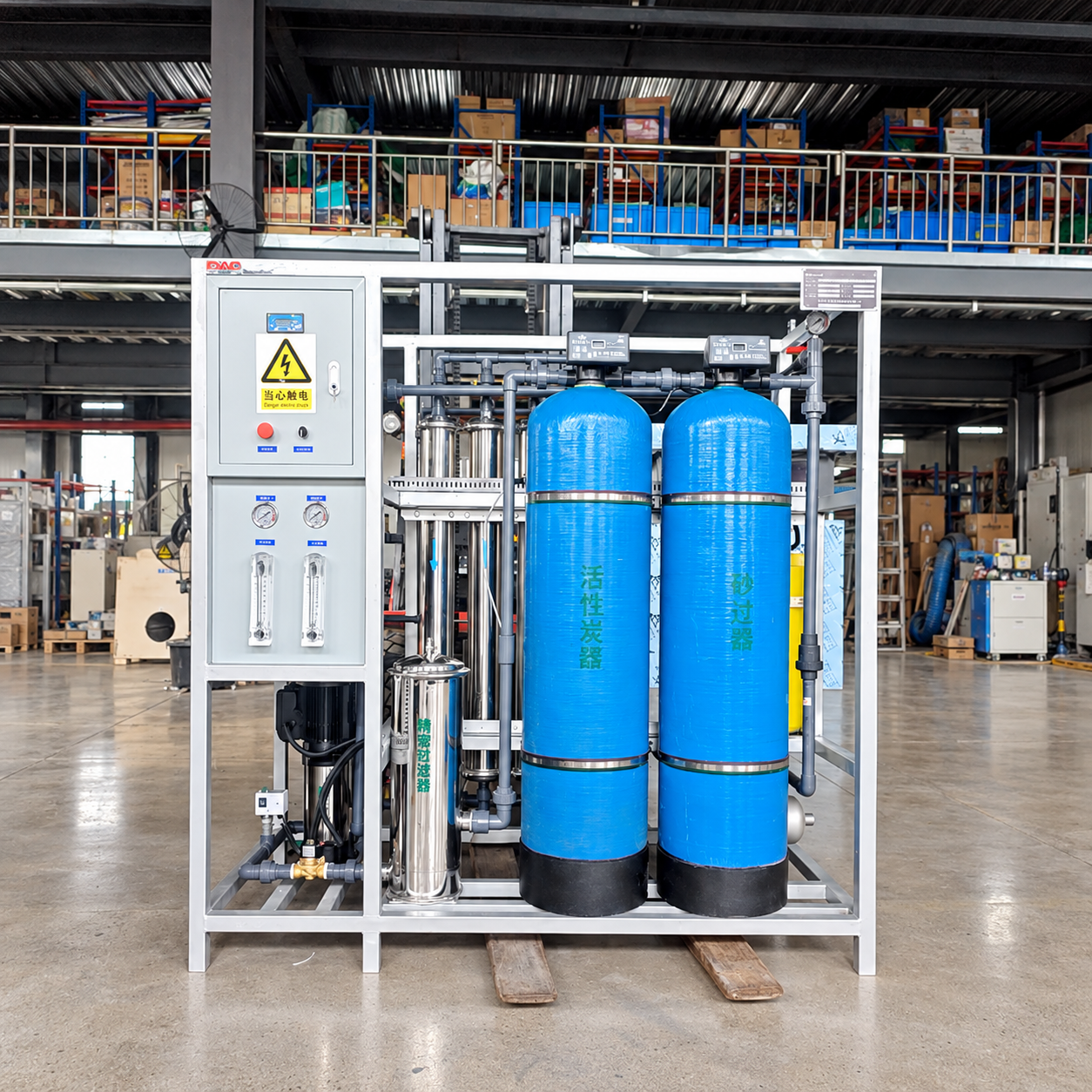
What is an integrated reverse osmosis machine: an integrated layout combines pretreatment and reverse osmosis within a single delivery boundary
An integrated reverse osmosis machine combines pretreatment units (such as multi-media filtration, activated carbon filtration, softening or scale inhibition, etc., with the specific configuration depending on the model) and the reverse osmosis main unit within the same equipment boundary, and the entire machine produces purified water through the reverse osmosis process. Ziyun Group / P&C this product is aimed at enterprises, institutions and engineering project owners that need stable production of purified water, with a rated water production of 250 or 500 L/h (corresponding models), filtration precision 0.0001 μm, power supply 220 V / 50 Hz, and the applicable water source is municipal tap water.
The key point to understand is the term "delivery boundary." It means that from raw water inlet to purified water output, the main treatment stages are completed by the same supplier within the same set of equipment, rather than the owner separately purchasing pretreatment tanks, the reverse osmosis main unit and control cabinets and then assembling them on their own.
Structural differences between an integrated layout and split assembly: number of interfaces and allocation of responsibility
The difference between the two is not just whether the appearance is compact; when it comes to a project, it mainly comes down to four dimensions:
- Number of interfaces: Split assembly requires multiple connections between the pretreatment outlet and the RO inlet, between control signals, and between electrical circuits;The integrated unit incorporates these interfaces inside the equipment, so on site only the inlet, outlet, power supply, and discharge need to be connected.
- Responsibility allocation: In the split configuration, when inadequate pretreatment causes RO membrane fouling, responsibility tends to be shifted between the two suppliers;With the integrated unit, a single delivery party is responsible for the entire treatment chain.
- Footprint and layout: The integrated layout requires a more concentrated site shape, while the split configuration can be arranged in a distributed manner, but with longer piping and more coordination.
- Change riskIn engineering projects, civil works, electrical, and piping schedules are often out of sync; the fewer the interfaces, the lower the probability of on-site changes and rework.
What the combination of pretreatment and reverse osmosis means, and what it does not mean
It means the owner receives a complete unit that has already taken into account the matching relationship between pretreatment and RO, and does not need to judge on their own whether the pretreatment effluent meets the RO feed water requirements. However, it does not mean that feed water conditions can be ignored: the product documentation clearly states that the applicable water source is municipal tap water. If the on-site water source is groundwater, surface water, or a water source with large water quality fluctuations, the suitability conclusion needs to be confirmed separately and cannot be directly applied. It also does not mean "maintenance-free"—the pretreatment filter media and membrane elements still have their own replacement and cleaning cycles. Automatic control reduces the frequency of manual operations, not the responsibility for routine inspections.
For the next step in judgment, first confirm three things: which level the actual water usage curve matches, 250 L/h or 500 L/h; whether the on-site water source is indeed municipal tap water; and whether the water inlet/outlet and power supply conditions at the installation site are satisfactory. Once these three points are clear, proceed to the cost and operation/maintenance comparison between the integrated unit and the split-type system.
Responsibility interface and installation coordination: with integrated unit delivery versus split-system procurement, who is clearer about being responsible for the interface
During project execution, whether interface responsibilities are clear directly affects communication costs when changes occur. The difference between integrated machines and split RO systems is first reflected in the number of interfaces.
Clarity of responsibility ownership: the difference between integrated delivery and multi-supplier assembly
Split RO systems purchase pretreatment and reverse osmosis units separately, resulting in more interfaces, and responsibility boundaries need to be divided among multiple suppliers. Once linkage or water output issues arise, the owner often needs to define the responsibility segments of each party on their own. Reverse osmosis integrated machines adopt an integrated layout, combining pretreatment and reverse osmosis within the same delivery boundary, making interface confirmation easier to write into the contract and responsibility ownership relatively centralized.
It should be noted that centralized responsibility does not mean risk disappears, but rather shifts to dependence on a single delivery party;If the project has special requirements for a certain process segment, the room for adjusting the standardized boundary needs to be confirmed in advance.
Installation coordination difficulty: coordination with civil works, electrical, and piping progress
The integrated machine reduces on-site assembly steps, but before installation it is still necessary to confirm in advance the power supply 220 V / 50 Hz, site, and piping conditions. These conditions can be submitted in a centralized manner before civil and electrical construction, reducing the probability of later rework;The difficulty lies in the fact that the overall unit layout has certain requirements for the site. The split configuration has lower space requirements for a single point, but the coordination requirements for civil works and piping progress are more detailed, and any delay in any link may propagate to the commissioning stage.
Whichever option is chosen, it is recommended to clearly specify in the contract the physical demarcation point between the equipment side and the owner side, as well as the responsibility allocation when interface conditions change, so as to reduce the risk of project interface changes.
Matching O&M manpower with water production capacity: how much labor can automatic control reduce, and how to choose between 250 and 500 L/h
The boundaries of automatic control: reducing operations does not equal maintenance-free
What automatic control changes is "whether a person needs to stay by the equipment at all times," not "whether the equipment needs human management." It delegates frequent start-stop, valve switching, and pressure and liquid level interlocking to the control system, reducing the time spent repeatedly going to the site to operate and watch parameters. However, daily inspection items still need to be clarified: judge whether pretreatment needs cleaning or cartridge replacement based on changes in differential pressure and water production, observe whether the RO stage water production performance drifts, and check pipes and fittings for leaks.
These items also exist in split-type systems; the difference is that the all-in-one machine concentrates the inspection points in one place, with a shorter inspection route and fewer interfaces. To judge labor savings, do not ask "can it be unattended," but rather ask whether the site needs someone to respond at any time, or whether weekly inspections with handling only when abnormalities occur are sufficient.
Judgment of matching rated water production of 250 or 500 L/h with the water usage curve
Water production should be selected using "average daily water consumption ÷ actual water use period" rather than directly comparing the average daily total to the rated value. Continuous operation at 250 L/h for several hours and short-term operation at 500 L/h may cover the same daily demand, but they have different requirements for water production time and storage buffer. A more prudent approach is to first tally the periods of highest water use and peak flow during the day, then check whether the rated water production capacity can replenish consumption within those periods.
An undersized model often has to rely on a storage tank as a buffer, while an oversized model may run at low load for long periods—both come at a cost. For the three data points—average daily water consumption, peak periods, and available storage space—it is recommended to explain them to the Ziyun team, let them determine whether the 250 or 500 L/h tier is a better match, and confirm whether the installation site and power conditions meet requirements. A split-type RO system involves more interfaces and components, so the inspection scope is relatively broader, and the specific workload depends on the on-site configuration.
When an integrated reverse osmosis unit is recommended and when it is not: conclusions and boundaries
First, the conclusion:For organizations with concentrated water use points, limited space, and a desire to consolidate pretreatment and reverse osmosis interfaces in one place, an integrated unit can be given priority consideration;In scenarios where the water source is not municipal tap water, or where the water use curve is not yet clear, it is recommended to confirm the conditions before selecting a model.
List of recommended and non-recommended scenarios: centralized water purification, project-support water production, and water source boundaries
Recommended scenarios:
- Centralized water purification for factories and industrial parks: Water usage points are dispersed but water production is centralized; an integrated layout can reduce the coordination of piping and electrical interfaces required for dispersed assembly.
- Water production supporting engineering projects: The equipment needs to be coordinated with civil construction, electrical, and piping schedules, with relatively fewer interfaces, but installation conditions must be confirmed in advance.
- Limited space for office and logistics renovation sites: When arranging split equipment is difficult, an integrated layout offers better adaptability to limited space.
- Limited operations and maintenance manpower: Automatic control can reduce routine manual operations, but the boundaries of automatic control and the daily inspection items still need to be clearly defined; it does not mean maintenance-free.
Scenarios not recommended or requiring prior confirmation:
- Water source is not municipal tap water: The product documentation explicitly states that the applicable water source is municipal tap water; conclusions on the suitability of other water sources are not provided and should not be inferred as usable;For well water, river water, reclaimed water, etc., the water quality conditions must be explained first before discussing a solution.
- Water usage profile and water production capacity have not been clearly calculated: The rated water production capacity is 250 or 500 L/h (depending on the model); selecting a model that is too large or too small is inappropriate, and before this figure is determined, it is not advisable to enter the price comparison stage.
Budget allocation and next steps: write interface confirmation and responsibility boundaries into the contract
Budget priorities to confirm firstMatching water production capacity with the water usage curve, to avoid investment waste or insufficient water supply;Second, evaluate the savings in installation coordination and O&M manpower from the integrated layout;Finally, write interface confirmation and responsibility boundaries into the contract, clarifying inlet water conditions, installation coordination, and automatic control boundaries, to reduce later change costs.
Next step: compile the water source type, daily water consumption, and installation site conditions, confirm model matching and interface division of responsibilities with Ziyun Group / P&C, and then decide on the integrated unit or split configuration.
Frequently Asked Questions
Q: The water source is a private well. Can this integrated machine be used? A: The applicable water source given in the materials is municipal tap water; there is no conclusion on suitability for well water. Water quality information must first be provided, and Ziyun Group / P&C will confirm whether additional pre-treatment is required, and then determine whether it can be selected.
Q: Which is less troublesome: an integrated machine or buying pre-treatment + reverse osmosis separately? A: An integrated machine usually has fewer interfaces, and the coordination steps are centralized;the split solution offers relatively more flexibility in component replacement. The trade-off lies in whether you care more about upfront coordination or later replacement flexibility.
Q: How should one choose between 250 L/h and 500 L/h? Answer: It depends on daily water consumption and the water usage curve; it should not be estimated based on peak values. Determine the model only after both figures are calculated clearly, to avoid choosing one that is too large or too small.
Question: Does automatic control mean no attention is needed? Answer: No. Automatic control reduces the frequency of manual operations, but routine inspections and abnormality judgment still require someone to be responsible; the specific inspection items should be confirmed with the supplier at the time of delivery.
Learn more
If you are selecting a water treatment solution for a project, you can organize the water source type, average daily water consumption, peak water usage periods, and installation site conditions and send them to Ziyun Group / P&C. We will help determine whether the 250 or 500 L/h option is a better match, and confirm the interface responsibilities and installation coordination matters accordingly.